
25 November 2026
,
Johannesburg

VERIFY Summit South Africa 2026

South Africa's dedicated event on identity, fraud and trust in the AI era

Building the Trust Infrastructure for the AI Economy
South Africa's move to real-time payments has changed how money leaves an account, and the fraud economy has followed it closely. PayShap now clears tens of millions of transactions a month, the payment system is opening to non-bank providers, and a national digital identity platform is still being built. Fraud has moved with the rails — digital banking crime is now the largest category the industry reports.

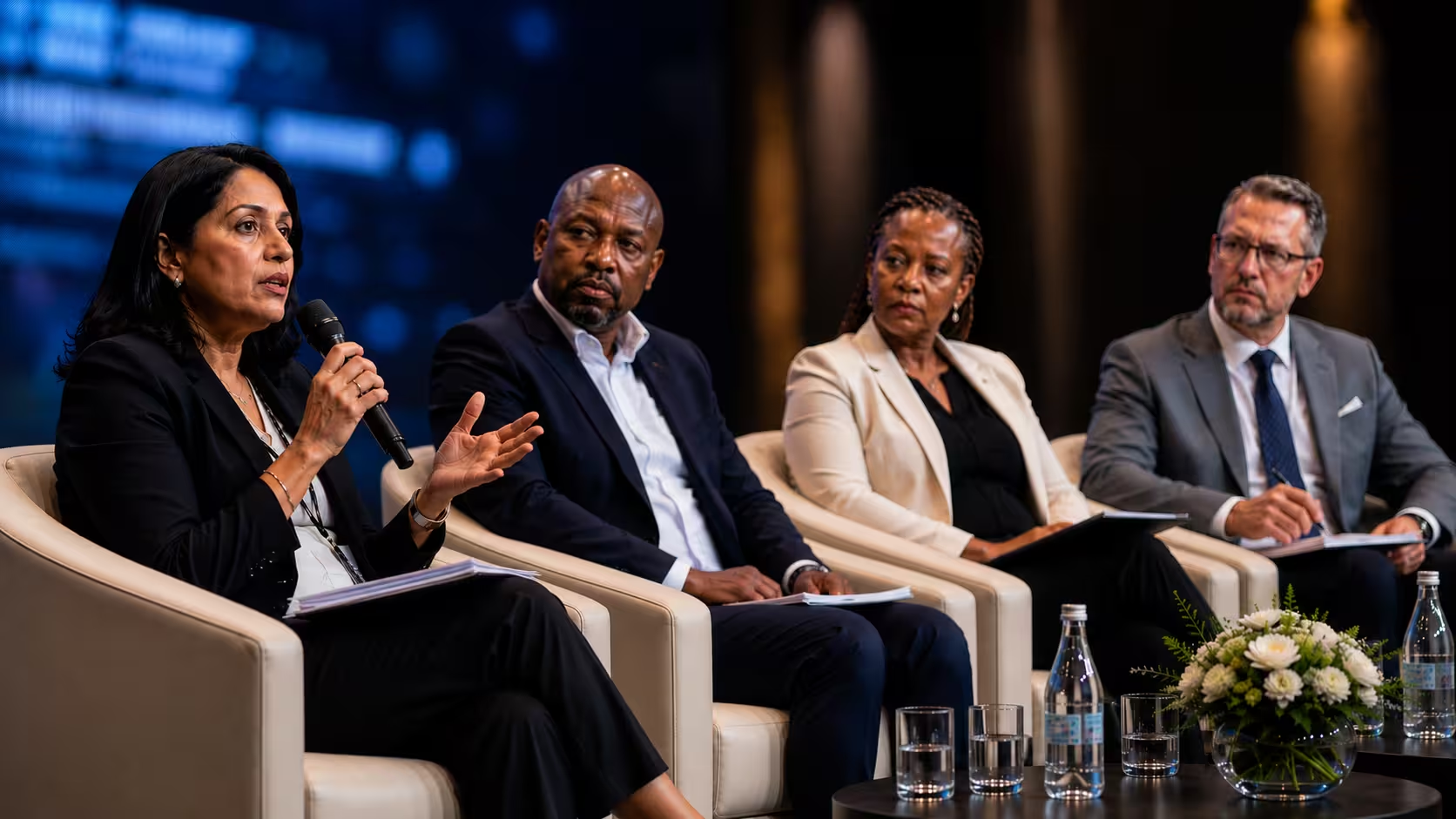
VERIFY South Africa convenes the leaders responsible for that response — across identity, authentication, fraud, financial crime, and trust — in banks, fintechs, telecoms and digital platforms. Bank-to-bank intelligence sharing already works in this market; the harder question is whether it reaches the mobile operator, the retailer and the platform where much of the attack actually happens. The summit examines where verification gets rebuilt, and how far the existing model can realistically extend.
Why VERIFY, why now
0 bn
Rand lost to digital banking crime in 2025
0 %
of digital banking losses come from banking apps
0 %
rise in fraudulent asset finance applications
0 m
PayShap transactions cleared since launch
Who Will Be There
A cross-functional room of senior leaders responsible for identity, fraud and trust across South Africa's financial and digital economy.
ROLES

Heads of Identity & Authentication · Heads of Digital Identity · Heads of Fraud & Financial Crime · Heads of Trust & Safety · Heads of Payments Risk · Chief Risk Officers

ORGANISATION TYPES

Banks & Digital Banks · Payment Service Providers · Fintechs & E-Wallets · Telecoms & Mobile Operators · E-Commerce & Digital Commerce · Regulators & National Infrastructure

What Makes VERIFY Summit Unique
Built for the people deciding who and what can be trusted.
Built around the trust layer, not a single threat
Identity verification, authentication, fraud detection and AML were built as separate systems and increasingly operate as one problem. The same synthetic identity clears a bank's onboarding and a marketplace's seller checks; the same deepfake defeats a contact centre and a video KYC flow. VERIFY Summit convenes the people building that layer across banking, payments, telecoms and digital commerce, alongside the technology partners working with them.
Built around live operational pressure
The agenda is shaped by what teams are dealing with now — AI-generated scams, synthetic identity at scale, deepfake impersonation, mule networks, agent-initiated transactions, and the reimbursement and coordination questions that follow. Sessions focus on investigation realities, deployment sequencing, and where institutions are still working things out, rather than on forecasts of what the threat landscape might look like in three years.
AI-driven defence, grounded in deployment
Discussions centre on how institutions are deploying AI across detection, authentication, investigation and response — what is already working, where it is failing, and how defence models are evolving as both sides begin operating at machine speed. The emphasis stays on deployed capability and operational sequencing: what is running in production today, and what the next stage of the build actually requires.
Agenda

8:00

8:45

Registration & Networking Breakfast

    8:45

    8:50

    Opening Remarks

      8:50

      9:30

      The Trust Infrastructure South Africa Is Building: Who Owns Trust When Payments Go Real-Time?

      PayShap cleared 905 million cumulative transactions by May 2026, with monthly volumes running roughly six times their 2025 average, and the SARB took a 50% stake in the governing entity in October 2025. The National Payment System is now opening to non-bank providers, while Home Affairs builds a national digital identity platform for 2027. Payments are getting faster and the participant list is getting longer.
      • Faster rails and new entrants are arriving together. Where does accountability sit when no single participant owns the customer's trust?
      • The payment system is opening to non-bank providers. What fraud baseline should apply before new entrants can clear transactions?
      • Real-time settlement removes the window recovery once depended on. How does the bank rebuild controls around irreversibility rather than delay?
      • Telecoms and online retail sit outside the banking framework entirely. Who sets the standard when no single regulator covers them all?

      9:30

      9:45

      How We Solved…

      A practical case study on a real industry challenge, the approach taken, and results achieved.

        9:45

        10:25

        Identity Assurance Before the Digital ID Arrives: Verifying People the System Cannot Yet Confirm

        Home Affairs has set March 2027 to complete hosting infrastructure for the national digital identity platform, with verifiable credentials issued from 2027/28 — and its own performance plan records that departmental cybersecurity maturity remains low. Meanwhile SABRIC attributes rising application fraud to synthetic identities, income misrepresentation and AI-generated supporting documents. Until the national platform is operational, institutions verify customers through the systems available today.
        • Fraudulent asset finance applications rose 41% in a single year. Where does the lender rebuild identity assurance at the point of application?
        • AI-generated payslips and supporting documents are increasingly used to defeat manual review. What does the institution verify when the document proves nothing?
        • The national digital ID is not yet operational. How does the bank sequence identity investment now without rebuilding the stack twice?
        • Deepfake voice and video are increasingly used against remote onboarding. Where does the institution add assurance without pushing customers back into branches?

        10:25

        10:30

        The Room Speaks: Morning Pulse

        A mid-morning audience pulse capturing how the room is recalibrating its position on the day's most contested operational questions.

          10:30

          11:00

          Networking Break

            11:00

            11:15

            How We Solved…

            A practical case study on a real industry challenge, the approach taken, and results achieved.

              11:15

              11:55

              The Origination Problem: SIM Swap, Scam Pages and the Fraud That Starts Outside the Bank

              Banking app-related crime accounted for more than 70% of the R2.4 billion in digital banking losses SABRIC recorded in 2025. Most of it starts elsewhere — a SIM swap executed at a mobile operator, a scam page hosted on a retail domain, a mule account recruited over social platforms. The bank sees the transaction. It rarely sees anything that happened before it.
              • SIM swap succeeds at the mobile operator, not the bank. Where do networks and banks share signal before the transfer clears?
              • Scam pages impersonate retailers long before any payment is attempted. How does the retailer take them down at meaningful speed?
              • Mule accounts are recruited openly on consumer social channels. Who disrupts the recruitment pipeline when it sits outside every institutional perimeter?
              • One synthetic identity opens a retail account and a bank account. Where does the merchant's verification standard actually meet the bank's?

              11:55

              12:10

              How We Solved…

              A practical case study on a real industry challenge, the approach taken, and results achieved.

                12:10

                12:50

                Know Your Agent: When Software Becomes the Customer

                AI agents that pay, transfer and transact on a customer's behalf are moving from demonstration to deployment, and South Africa's payment system is opening to non-bank providers at the same moment. Behavioural models profile how a human transacts; an agent transacts differently, faster, and on the instruction of someone who never touched the screen. Know-Your-Customer was designed for a person. What happens when the customer isn't the one transacting?
                • Behavioural models assume a human at the keyboard. What breaks in detection when an AI agent transacts at machine pace?
                • An agent initiating a PayShap transfer never passes an authentication challenge. Where does verification move when the customer is never present?
                • A manipulated agent could transact at scale before anyone notices. Who holds the kill-switch, and how fast does it operate?
                • Agent identity is being defined now across banks and platforms. What standard does the bank adopt before the market fragments?

                12:50

                13:05

                How We Solved…

                A practical case study on a real industry challenge, the approach taken, and results achieved.

                  13:05

                  13:45

                  Collective Defence: Extending the Model Beyond Banking

                  South Africa already has what most markets are still arguing about — an industry body through which banks share crime intelligence, and annual statistics detailed enough to direct investment. The model works within banking. It does not reach the mobile operator where the SIM swap happened, the retailer whose brand was cloned, or the platform where the mule was recruited.
                  • Bank-to-bank intelligence sharing already works in this market. What would it take to bring telecoms into the same reporting structure?
                  • POPIA governs what institutions can share about customers. Where does the legal boundary actually sit for cross-sector fraud signal today?
                  • Real-time rails leave no window for after-the-fact recovery. How fast must shared fraud intelligence move to be operationally useful at all?
                  • Victim reimbursement is rising up the international agenda. What reimbursement model would work in South Africa without distorting institutional incentives?

                  13:45

                  13:50

                  The Room Speaks: Closing Pulse

                  A final audience reflection measuring how perspectives shifted across the day's discussions.

                    13:50

                    13:55

                    Closing Remarks

                      13:55

                      14:40

                      VIP Networking Lunch

                        Contact Us
                        Whether attending as a delegate or exploring sponsorship, contact us to discover exciting opportunities at our upcoming events.
                        Request your invitation
                        Join senior decision-makers and industry peers for a focused programme of insights, discussion, and networking. Attendance is complimentary for qualified professionals, subject to approval.
                        Thank you! Your submission has been received!
                        Oops! Something went wrong while submitting the form.
                        Partner with Us
                        Showcase your expertise, build new relationships, and engage directly with senior decision-makers. Explore sponsorship, speaking, branding, and business development opportunities tailored to your objectives.
                        Share your insights
                        Share your experience, case study, or perspective with an audience of senior professionals. We welcome submissions from practitioners, industry leaders, and subject-matter experts with relevant insights to contribute.
                        Thank you! Your submission has been received!
                        Oops! Something went wrong while submitting the form.
                        © Copyright 2026-28