
27 January 2027
,
Jakarta

VERIFY Summit Indonesia 2027

Indonesia's dedicated event on identity, fraud and trust in the AI era

Building the Trust Infrastructure for the AI Economy
Indonesia's expansion of QR payments, real-time transfers, e-wallets and platform commerce has reshaped how the country moves money, and the fraud economy has followed it just as quickly. Scams begin on messaging apps and marketplace listings, run through accounts opened with borrowed identities, and settle before anyone reviews them. Identity verification, authentication, fraud detection and AML were built as separate disciplines and increasingly answer to one problem.

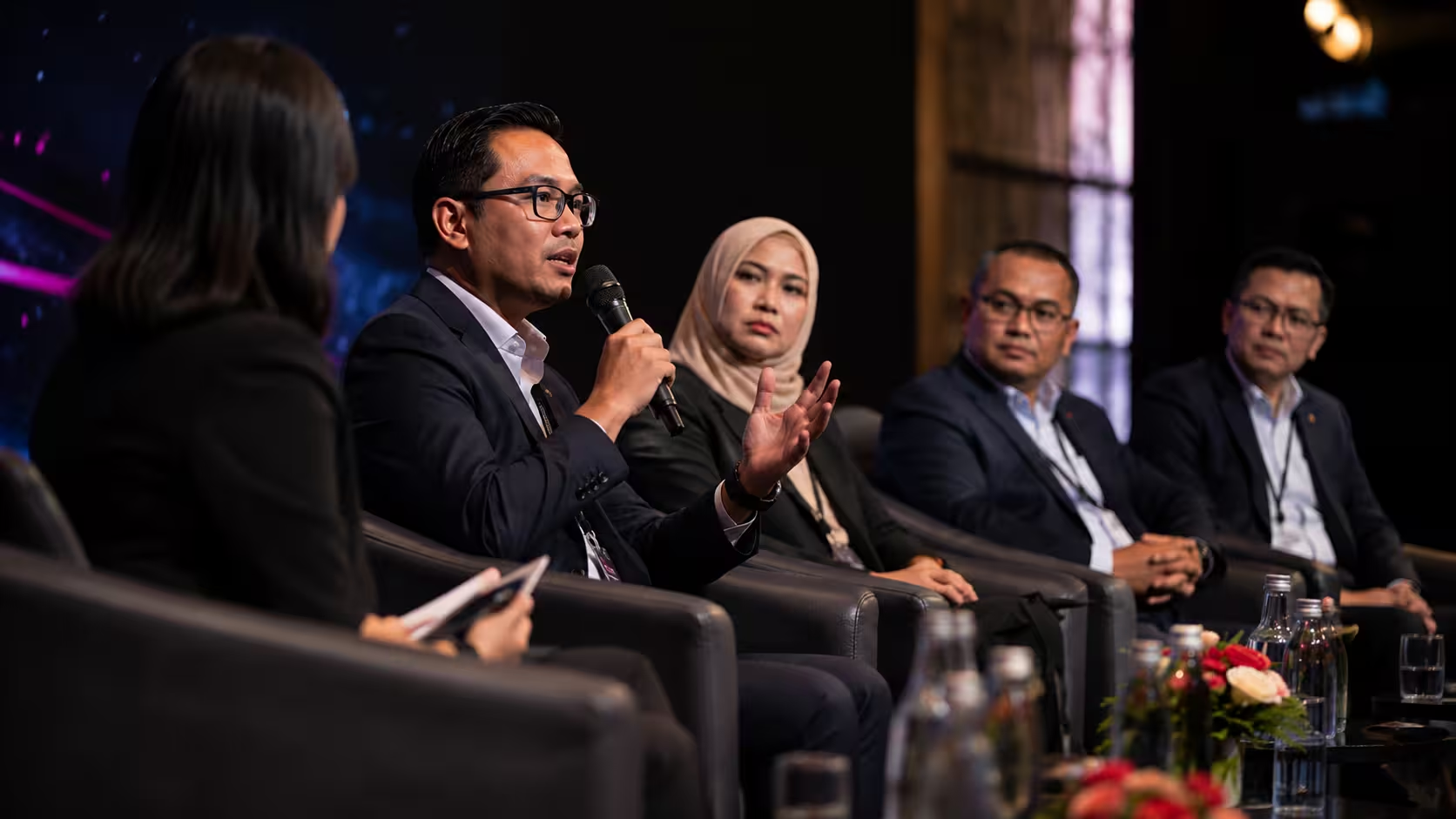
VERIFY Indonesia convenes the leaders responsible for that response — across identity, authentication, fraud, financial crime, and trust — in banks, fintechs, telecoms and digital platforms. The Indonesia Anti-Scam Centre already brings the regulator, banks, platforms and payment firms into one structure; the harder question is speed. The summit examines where verification gets rebuilt, and how fast a shared defence has to move on rails that settle in seconds.
Why VERIFY, why now
0 bn
QRIS transactions in the first half of 2026
0 k
scam reports to the Anti-Scam Centre since 2024
0 k
accounts blocked over suspected scam links
0
banks, non-banks and switches in the QRIS ecosystem
Who Will Be There
A cross-functional room of senior leaders responsible for identity, fraud and trust across Indonesia's financial and digital economy.
ROLES

Heads of Identity & Authentication · Heads of Digital Identity · Heads of Fraud & Financial Crime · Heads of Trust & Safety · Heads of Payments Risk · Chief Risk Officers

ORGANISATION TYPES

Banks & Digital Banks · Payment Service Providers · Fintechs & E-Wallets · Telecoms & Mobile Operators · E-Commerce & Digital Commerce · Regulators & National Infrastructure

What Makes VERIFY Summit Unique
Built for the people deciding who and what can be trusted.
Built around the trust layer, not a single threat
Identity verification, authentication, fraud detection and AML were built as separate systems and increasingly operate as one problem. The same synthetic identity clears a bank's onboarding and a marketplace's seller checks; the same deepfake defeats a contact centre and a video KYC flow. VERIFY Summit convenes the people building that layer across banking, payments, telecoms and digital commerce, alongside the technology partners working with them.
Built around live operational pressure
The agenda is shaped by what teams are dealing with now — AI-generated scams, synthetic identity at scale, deepfake impersonation, mule networks, agent-initiated transactions, and the reimbursement and coordination questions that follow. Sessions focus on investigation realities, deployment sequencing, and where institutions are still working things out, rather than on forecasts of what the threat landscape might look like in three years.
AI-driven defence, grounded in deployment
Discussions centre on how institutions are deploying AI across detection, authentication, investigation and response — what is already working, where it is failing, and how defence models are evolving as both sides begin operating at machine speed. The emphasis stays on deployed capability and operational sequencing: what is running in production today, and what the next stage of the build actually requires.
Agenda

8:15

9:05

Registration & Networking Breakfast

    9:05

    9:10

    Opening Remarks

      9:10

      9:50

      The Trust Infrastructure Indonesia Is Building: Who Owns Trust Across 160 Participants?

      QRIS cleared 12.55 billion transactions in the first half of 2026, worth Rp600.69 trillion — double the volume of a year earlier — while BI-FAST processed 1.5 billion transactions in the second quarter alone. The ecosystem now spans 96 banks, 60 non-bank institutions and four switching operators, most of its merchants micro and small businesses. Trust is distributed across every one of them.
      • The payment ecosystem spans a hundred and sixty participants. Where does accountability sit when no single institution owns the customer?
      • Most QRIS merchants are micro and small businesses. What verification standard is realistic at the smallest end of the rail?
      • Volumes doubled in a year while controls scaled linearly. Where does the bank invest first when growth outpaces the defence?
      • Telecoms and digital commerce sit outside the financial regulatory perimeter. Who sets the standard when no single regulator covers them all?

      9:50

      10:05

      How We Solved…

      A practical case study on a real industry challenge, the approach taken, and results achieved.

        10:05

        10:45

        The Account Is the Attack Surface: Identity Assurance When Mule Networks Operate at Scale

        OJK has blocked more than 557,000 accounts suspected of links to scam networks, and the Anti-Scam Centre is reviewing hundreds of thousands more. Borrowed identities, purchased documents and AI-generated supporting material are increasingly used to clear verification designed for a slower, smaller market. Every one of those accounts opened cleanly.
        • Half a million accounts were blocked after they opened. Where does the bank move detection earlier in the onboarding journey?
        • Mule accounts are often opened by real people knowingly. What does the institution verify when the identity itself is genuine?
        • Deepfake voice and video are increasingly used against remote onboarding. Where does the bank add assurance without losing the inclusion gains?
        • E-wallets and banks onboard against the same national identity records. Who raises the floor when the weakest verifier sets it?

        10:45

        10:50

        The Room Speaks: Morning Pulse

        A mid-morning audience pulse capturing how the room is recalibrating its position on the day's most contested operational questions.

          10:50

          11:20

          Networking Break

            11:20

            11:35

            How We Solved…

            A practical case study on a real industry challenge, the approach taken, and results achieved.

              11:35

              12:15

              The Origination Problem: Where the Scam Begins Before the Payment Moves

              Online shopping fraud is Indonesia's most reported scam category, and OJK has warned that fraud networks are increasingly exploiting payment systems, merchant channels and virtual assets to move outside standard tracking. The approach begins on a messaging app, a marketplace listing or a social feed — none of it visible to the institution that will carry the loss. The bank sees the payment and nothing before it.
              • Online shopping fraud leads every reported scam category in Indonesia. Where does the marketplace intervene before the buyer reaches payment?
              • Fraud networks are moving into merchant channels and virtual assets. How does the institution track value once it leaves regulated rails?
              • Recruitment and approach happen on consumer messaging and social platforms. Who disrupts the pipeline when it sits outside every institutional perimeter?
              • Telecoms hold the number that anchors every wallet. Where does the mobile operator share signal with the bank before funds move?

              12:15

              12:30

              How We Solved…

              A practical case study on a real industry challenge, the approach taken, and results achieved.

                12:30

                13:30

                Lunch & Prayer Break

                  13:30

                  14:10

                  Know Your Agent: When Software Becomes the Customer

                  AI agents that pay, transfer and transact on a customer's behalf are moving from demonstration to deployment, and Indonesia's payment rails already run at a scale and speed that leaves little room for human review. Behavioural models profile how a human transacts; an agent transacts differently, faster, and on the instruction of someone who never touched the screen. Know-Your-Customer was designed for a person. What happens when the customer isn't the one transacting?
                  • Behavioural models assume a human at the keyboard. What breaks in detection when an AI agent transacts at machine pace?
                  • An agent initiating a QRIS payment never passes an authentication challenge. Where does verification move when the customer is never present?
                  • A manipulated agent could transact at scale before anyone notices. Who holds the kill-switch, and how fast does it operate?
                  • Agent identity is being defined now across banks and platforms. What standard does the bank adopt before the market fragments?

                  14:10

                  14:25

                  How We Solved…

                  A practical case study on a real industry challenge, the approach taken, and results achieved.

                    14:25

                    15:05

                    Collective Defence: The Model Exists — Can It Move Fast Enough?

                    Indonesia built what most markets are still designing: a national anti-scam centre bringing together the regulator, banks, e-commerce platforms and payment firms, operating since November 2024. It has frozen Rp674 billion and returned close to Rp200 billion. Against reported losses in the trillions, and with victims reporting on average many hours after the event, the constraint is no longer structure. It is speed.
                    • International practice puts victim reporting within minutes, not hours. What would actually close that reporting gap in the Indonesian market?
                    • Frozen funds far exceed the amount ultimately returned to victims. Where does the recovery process lose time between freeze and restitution?
                    • The centre already includes platforms and payment firms. What would it take to bring telecoms fully into the same structure?
                    • Real-time rails leave no window for after-the-fact recovery. How fast must shared fraud intelligence move to be operationally useful at all?

                    15:05

                    15:10

                    The Room Speaks: Closing Pulse

                    A final audience reflection measuring how perspectives shifted across the day's discussions.

                      15:10

                      15:15

                      Closing Remarks

                        15:15

                        16:00

                        Networking Reception

                          Contact Us
                          Whether attending as a delegate or exploring sponsorship, contact us to discover exciting opportunities at our upcoming events.
                          Request your invitation
                          Join senior decision-makers and industry peers for a focused programme of insights, discussion, and networking. Attendance is complimentary for qualified professionals, subject to approval.
                          Thank you! Your submission has been received!
                          Oops! Something went wrong while submitting the form.
                          Partner with Us
                          Showcase your expertise, build new relationships, and engage directly with senior decision-makers. Explore sponsorship, speaking, branding, and business development opportunities tailored to your objectives.
                          Share your insights
                          Share your experience, case study, or perspective with an audience of senior professionals. We welcome submissions from practitioners, industry leaders, and subject-matter experts with relevant insights to contribute.
                          Thank you! Your submission has been received!
                          Oops! Something went wrong while submitting the form.
                          © Copyright 2026-28