
27 October 2026
,
Riyadh

4WARD Saudi Arabia 2026

Saudi Arabia's dedicated industrial AI event

From Pilot to Production: Building the Intelligent Industry
Saudi Arabia’s industrial AI agenda has moved from possibility to execution. Under Vision 2030, the National Industrial Strategy, and the Future Factories Programme, the Kingdom is pushing industrial enterprises towards higher efficiency, automation, and advanced operations, backed by national investment in the AI, compute, and data infrastructure the next phase of transformation will demand.

The real challenge now sits inside the enterprise: applying AI to improve assets, plants, production systems, and critical operations in ways that are reliable, governed, and measurable. That requires a practical conversation about how industrial AI is deployed, trusted, secured, and scaled.

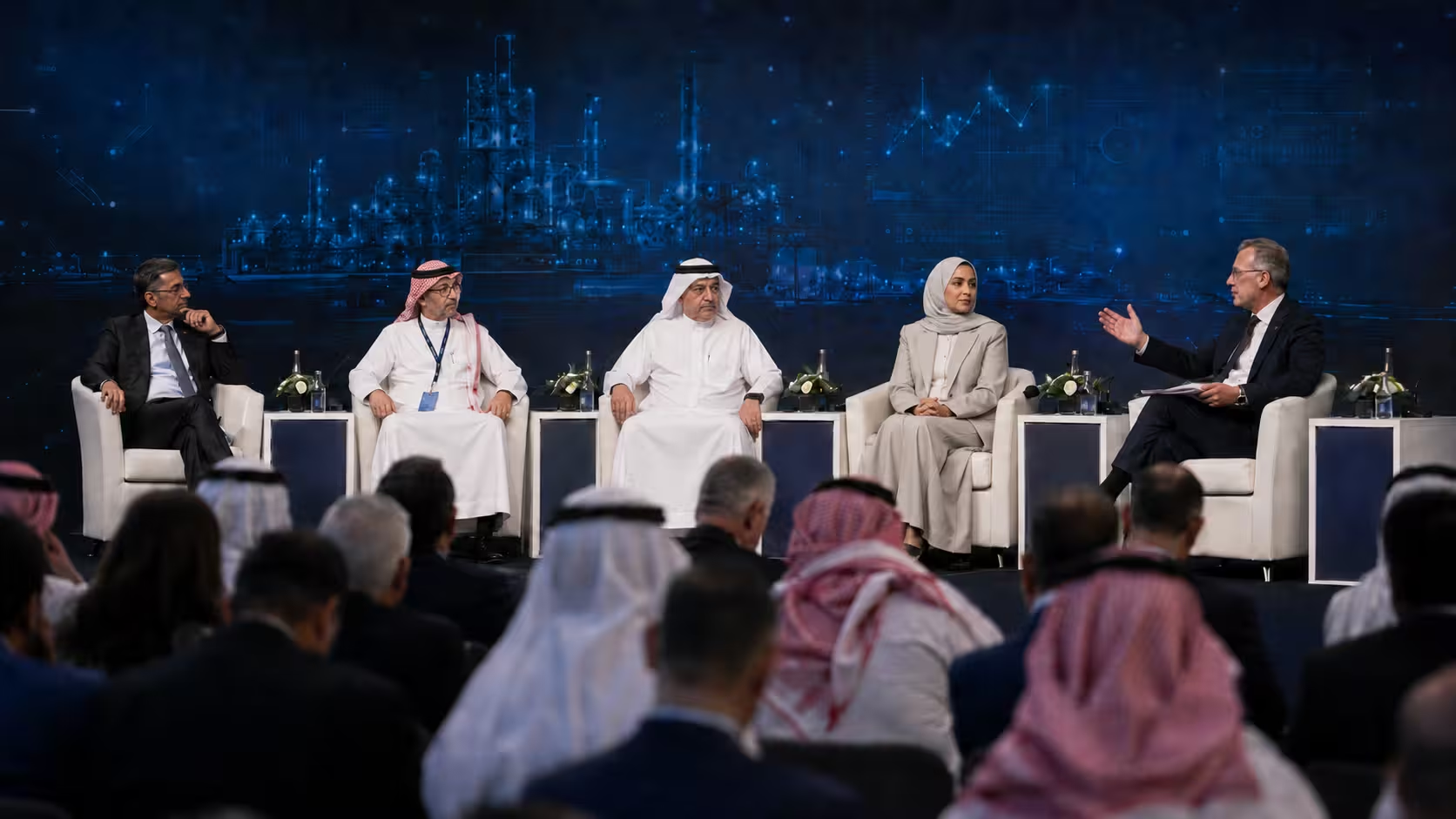
4WARD brings that conversation into one senior, operator-led forum for the leaders responsible for turning AI ambition into operating capability across asset-intensive industries.

The agenda focuses on the decisions that determine whether industrial AI succeeds in production: use-case readiness, deployment in complex industrial environments, integration with existing systems, governance and security, operating-team adoption, and value at scale.
Why 4WARD, why now
0 +
Factories being upgraded under the Future Factories Programme
0 B+
AI's projected contribution to the Saudi economy by 2030 (USD)
77 B+
National investment in data & AI infrastructure (PIF strategy, USD)
0 B+
New investment targeted in the industrial sector by 2030 (USD)
Who will be there
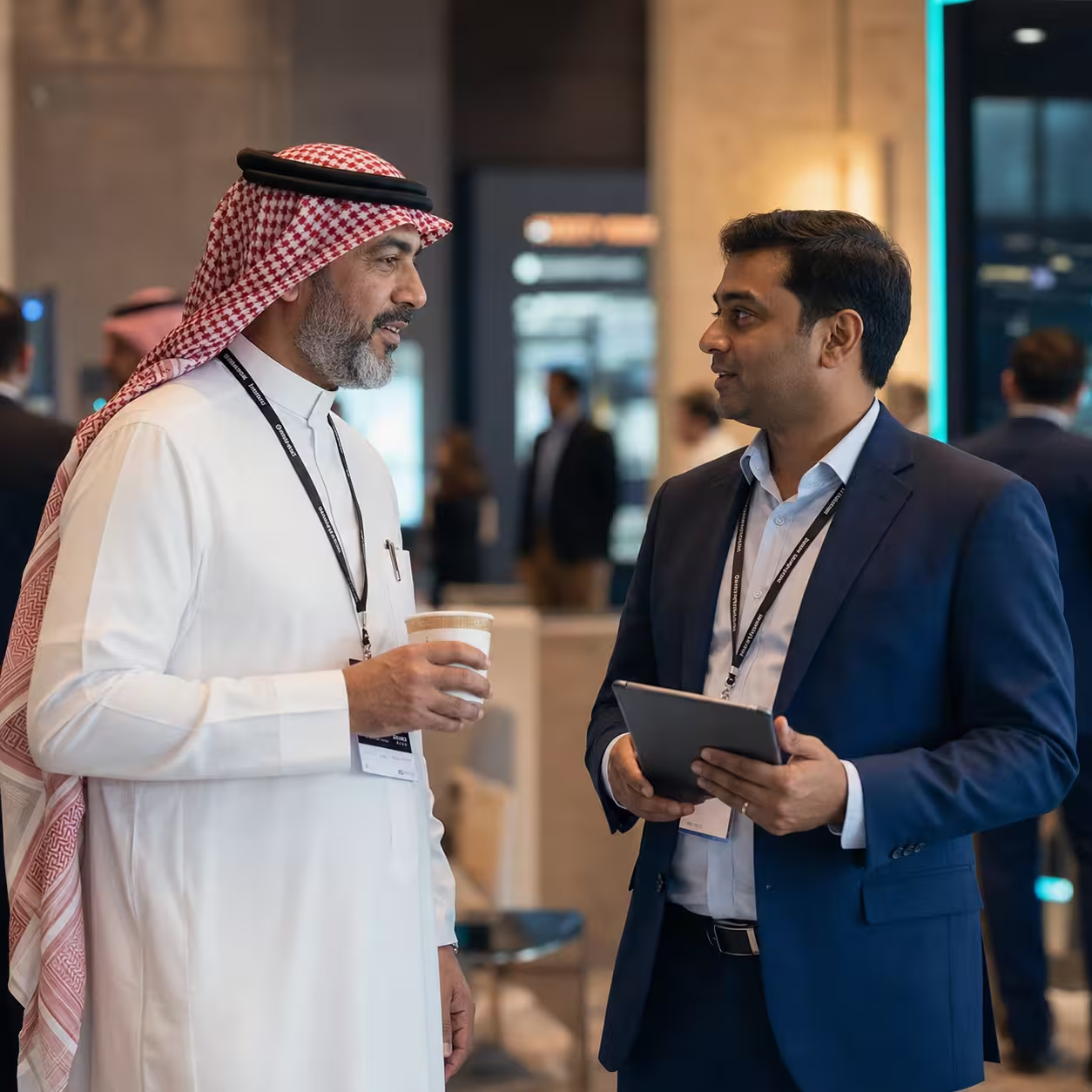
Senior operations and technology leadership from asset-intensive industries across the Kingdom
ROLES

COOs & Operations Directors
Plant, Factory & Site Directors
Heads of Asset Performance, Maintenance & Reliability
CDOs, CIOs & Digital Transformation Leaders
Heads of Data, AI & Analytics
Heads of OT, Automation & Industrial Technology

ORGANISATION TYPES

Energy & Chemicals
Mining & Metals
Industrial Manufacturing
Automotive, Aerospace & Defence
Utilities & Critical Infrastructure
Heavy Process Industries

Built around the operational reality of Industrial AI
For leaders deploying AI across plants, production assets, and live industrial operations
Beyond the pilot stage
This summit focuses on what happens when industrial AI moves from pilot environments into live operations — plants, remote facilities, maintenance workflows, and uptime-critical infrastructure where reliability, safety, and operational consequence matter.
Built around Saudi industrial reality
The agenda is shaped around the sectors driving the Kingdom's industrial expansion — energy, petrochemicals, mining, utilities, and heavy manufacturing — and the operational pressures these industries are actively working through under Vision 2030.
What actually worked - and what didn't
Sessions focus on implementation reality: what delivered measurable operational value, what failed under production conditions, where integration became difficult, and what changed once AI met legacy infrastructure, workforce reality, and industrial scale.
Agenda

8:00

8:30

Registration & Networking Coffee

    8:30

    8:35

    Opening Remarks

      8:35

      9:00

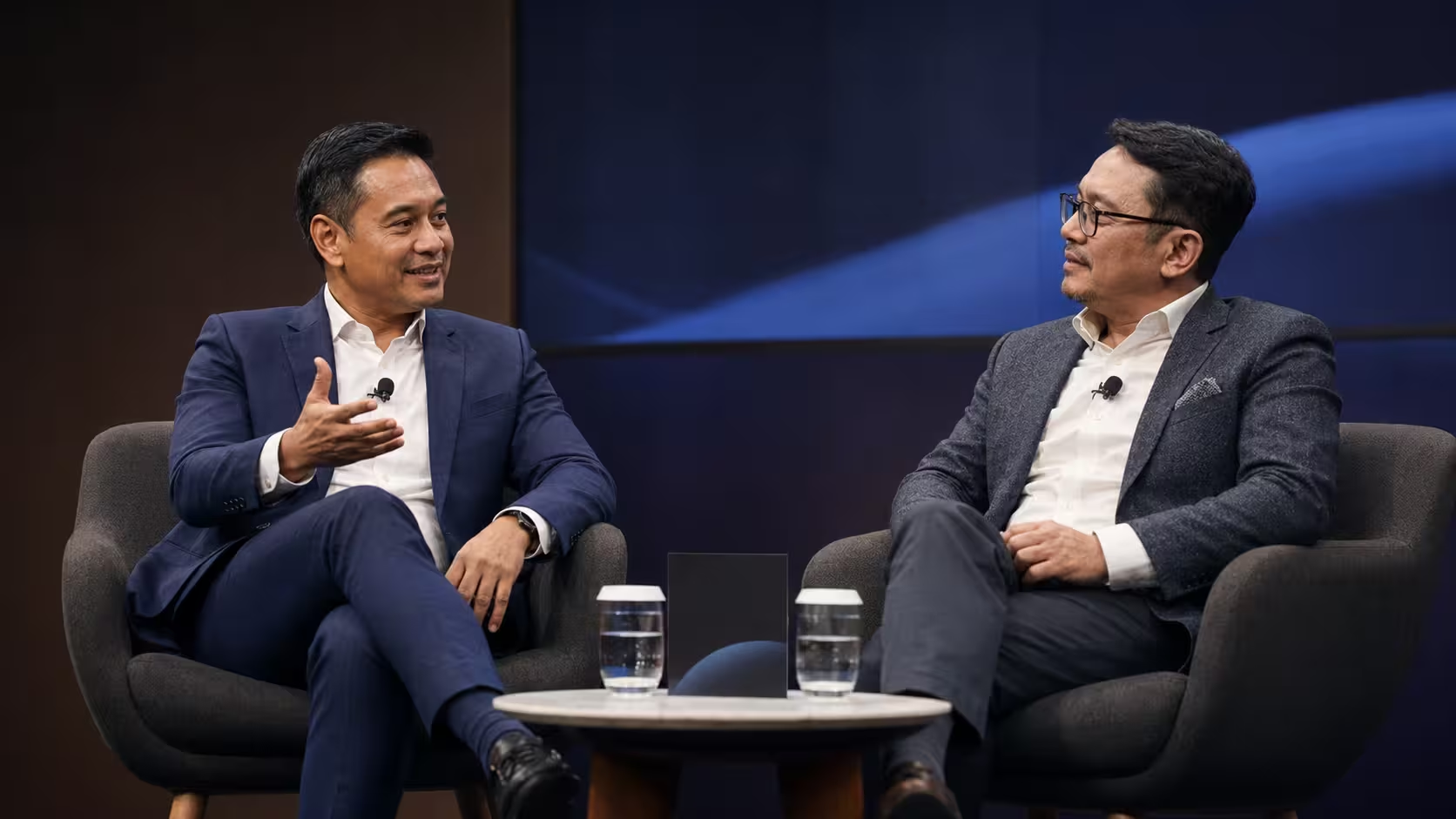
      The Implementation Phase: Can Saudi Industrial AI Deliver Operational Value?

      Saudi Arabia's AI infrastructure build-out is well underway. HUMAIN, SDAIA, and national compute investment are establishing where the models, data centres, and platforms will come from. The harder question is execution: can industrial operators turn that capacity into measurable value on the plant, the asset, and the field? Most industrial AI still stalls between a successful pilot and production. This opening panel asks what separates the operators capturing real returns from those still proving concepts.
      • Even as the infrastructure build-out advances, why does so much industrial AI still stall before reaching a single production decision?
      • Scaling depends on more than the right platform or partner. What does the operator need to own internally to reach production?
      • AI value shows up in the numbers or it does not. Where are operators seeing genuine return, and where is the case unproven?
      • The Future Factories Programme targets 4,000 plants. What has to change operationally for AI to move them, not just digitise them?

      9:00

      9:30

      The Industrial Data Problem: Why AI Fails Before the Model Is Even Built

      Many industrial AI projects break down long before the model. Operational data sits trapped across historians, SCADA, MES, ERP, vendor systems, and spreadsheets — uncontextualised, untrusted, and ungoverned. Recent PwC research on Saudi AI maturity points to a clear data-access gap: organisations are adopting AI faster than they are preparing the data foundations to scale. The question is not which model to deploy; it is whether the data underneath is usable, trusted, and governed enough to deploy anything at all.
      • Industrial data is harder than enterprise data. Where do Saudi operators actually start when historian, MES, and ERP data refuse to reconcile?
      • Raw sensor readings are not operational intelligence. What does it take to contextualise plant data into something a model can trust?
      • Data sovereignty and PDPL shape every industrial AI project. How does the operator build governed foundations without a three-year programme?
      • Who owns industrial data — IT, OT, engineering, or operations? Where does that unresolved question hold AI projects back before launch?

      9:30

      9:45

      How We Solved...

      A practical case study on a real industry challenge, the approach taken, and results achieved.

        9:45

        9:50

        The Room Speaks: Morning Pulse

        A live audience pulse check capturing the priorities and pressures shaping industrial AI adoption today.

          9:50

          10:20

          Proving Value in Predictive Maintenance: From Asset Data to Defensible Returns

          Predictive maintenance is the most commercially credible industrial AI use case in the Kingdom — heavy assets, extreme conditions, and remote sites make unplanned downtime expensive. But detecting a failing asset weeks early is not the same as proving a return that finance can stand behind. This panel examines how operators turn vibration, temperature, and historian data into models that demonstrably reduce downtime, and how they earn the trust of maintenance teams who trust experience first.
          • A model flags a failing asset weeks early. How does the operator convert that into a return finance will actually defend?
          • Capital-intensive plants lose millions per unplanned shutdown. Where does predictive AI genuinely pay back, and where is the business case overstated?
          • Maintenance teams trust hard experience over algorithms. What earns real operator buy-in when a model contradicts decades of plant intuition?
          • Sensor and historian coverage is partial in most legacy plants. What does the operator do when the data foundation is visibly incomplete?

          10:20

          10:35

          Networking Break

            10:35

            11:05

            Industrial AI Beyond the Factory: Energy, Mining, Logistics, and the Wider Saudi Asset Base

            Saudi industrial AI is not confined to the factory floor. The Kingdom's real asset base spans energy and petrochemical plants, mining operations, ports, logistics corridors, utilities, and industrial cities — many with deeper operational data and harder constraints than discrete manufacturing. This panel examines where AI is delivering across that wider system, and what sectors with mature asset data can teach those just beginning to turn operational data into decisions.
            • Energy and petrochemical operators sit on decades of asset data. Where is AI moving reliability and yield, not just dashboards?
            • Mining operations face safety, remoteness, and massive scale. Where does AI deliver most across exploration, asset reliability, and operational decisions?
            • Ports, logistics corridors, and industrial cities run on flow. Where does AI optimise the movement of goods, not the machines moving them?
            • Mature-data sectors run years ahead of others. What can early-stage operators borrow from energy and mining without copying it blindly?

            11:05

            11:35

            Edge Intelligence: Running Industrial AI Where the Cloud Cannot Reach

            Much of Saudi industry runs where the cloud cannot — remote desert facilities, offshore platforms, mines, and pipelines hundreds of kilometres from the nearest data centre. AI that depends on a round trip cannot make a real-time decision there, so intelligence has to run on the asset itself. And as edge models grow more capable, they increasingly act rather than advise, raising hard questions about what an operator lets run autonomously, on what hardware, across thousands of distributed sites.
            • Remote sites, offshore platforms, and connectivity-thin assets cannot wait for the cloud. Where must AI inference run on the asset itself?
            • Edge hardware faces extreme heat, limited power, and rare physical access. What actually survives Saudi field conditions, and what does not?
            • Edge AI increasingly acts rather than advises. Where can an agent safely act on the asset without a cloud round trip?
            • Models multiply across thousands of distributed assets, widening the OT attack surface. How does the operator secure and monitor them?

            11:35

            12:00

            Prayer & Networking Break

              12:00

              12:15

              How We Solved...

              A practical case study on a real industry challenge, the approach taken, and results achieved.

                12:15

                12:45

                Safe AI for Critical Operations: Governance, OT Security, and Accountability

                In industrial environments, a bad AI recommendation is not a minor error — it can mean downtime, an environmental release, or a safety incident. As AI shifts from advising to acting, the accountability question sharpens. Saudi Arabia has built structure here through NCA OT controls, the SDAIA framework, and PDPL data rules. This panel examines how operators validate AI before it touches operations, who stays accountable when an autonomous system is wrong, and how the roadmap applies on the floor.
                • A bad recommendation in a plant is not a minor error. How does an operator validate a model before it touches live operations?
                • As AI moves from advising to acting, who stays accountable for an autonomous decision, and where must a human keep the final sign-off?
                • NCA's controls, SDAIA's framework, and PDPL data rules set the floor. How do operators apply that roadmap to plant-floor AI without guesswork?
                • Models drift, vendors change, data shifts. Who owns ongoing monitoring, and what makes an industrial AI decision auditable after the fact?

                12:45

                13:00

                How We Solved...

                A practical case study on a real industry challenge, the approach taken, and results achieved.

                  13:00

                  13:30

                  From Pilot to Production Value: What Saudi Industry Must Do Now

                  The day has mapped the gap — data foundations, the credible use cases, the wider asset base, the edge, the autonomy frontier, the governance line. This closing dialogue does not re-open it. It asks what each operator commits to next: what to build internally versus buy, how to measure return honestly, and what successful deployment actually looks like twelve months out. It ends by pressing the room from discussion to commitment.
                  • Every operator named the same blockers — data, talent, integration, governance. Which one does the room commit to fixing first?
                  • Build internally or buy from vendors? Where is the line that keeps the operator in control of its own AI roadmap?
                  • Twelve months from now, what does a genuinely scaled deployment look like — and what should every operator stop doing today?
                  • Beyond intentions, what is the one operational change each operator will make this year to move from pilot to production value?

                  13:30

                  13:35

                  The Room Speaks: Closing Pulse

                  A final audience reflection measuring how perspectives shifted across the morning's discussions.

                    13:35

                    13:40

                    Closing Remarks

                      13:40

                      14:25

                      VIP Networking Lunch

                        Contact Us
                        Whether attending as a delegate or exploring sponsorship, contact us to discover exciting opportunities at our upcoming events.
                        Thank you! Your submission has been received!
                        Oops! Something went wrong while submitting the form.
                        © Copyright 2026-28